A world‑first independent review has confirmed Australian farmers are achieving large‑scale sustainability outcomes under some of the toughest climatic conditions on earth.
A world‑first independent review has confirmed Australian farmers are achieving large‑scale sustainability outcomes under some of the toughest climatic conditions on earth.
The report, ‘Climate-smart agriculture: Australian sustainable farming practices enabled by plant science innovation, an independent technical review’ sets out a comprehensive account of how Australian agriculture has become a global leader in science‑based, sustainable production.
Dr John Rochecouste
Commissioned by CropLife Australia and authored by independent agronomic scientist Dr John Rochecouste, the review draws on peer‑reviewed research, national datasets and real‑world case studies.
Together, they show an agricultural sector producing more food with fewer resources, all while reducing its environmental footprint.
The findings underline a simple but powerful reality: when innovation drives farm practice, productivity and environmental performance go hand in hand.
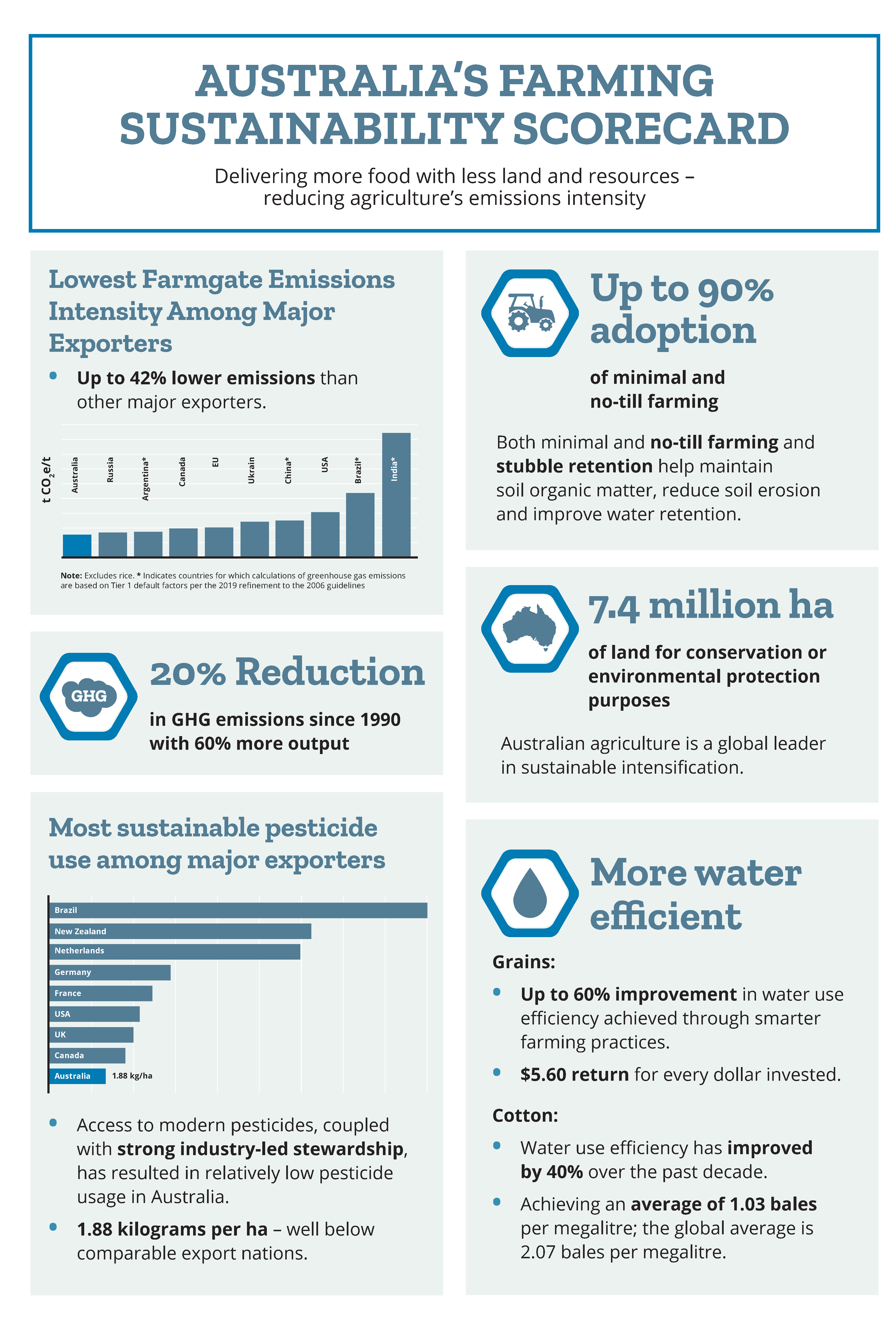
Among the report’s most striking insights is Australia’s position as the lowest‑emissions major agricultural exporter, with emissions up to 42 per cent lower than comparable nations.
In the past three decades, farm output has climbed 60 per cent even as agricultural emissions have fallen 20 per cent.
Conservation agriculture now dominates, with more than 90 per cent of crops grown using minimum‑ or no‑till farming – boosting soil health, reducing erosion and improving water retention.
Water‑use efficiency is also surging.
Cotton growers now produce 40 per cent more lint per megalitre than a decade ago, far outperforming the global average, while grain growers have lifted efficiency by 60 per cent, generating strong economic returns.
The report highlights how Australia has decoupled agricultural growth from land use, producing significantly more on significantly less land than 30 years ago.
Modern chemistry, precision technologies and stewardship programs have helped Australia record the most sustainable pesticide‑use profile among comparable exporters.
But the review also issues a warning.
Rising heat, water scarcity and intensifying pest pressures threaten to erode recent gains unless farmers retain access to new technologies.
Matthew Cossey
CropLife Australia chief executive Matthew Cossey says this success has never been accidental.
“Australian farmers operate in one of the most variable and challenging climates of any major agricultural nation,” he says.
“Their achievements have been driven by science, innovation and stewardship.”
The report also underscores the decisive role of plant science innovations – from advanced genetics and biotechnology to modern crop protection and precision tools.
And highlights the consequences when access to innovation is restricted, pointing to countries such as Brazil, where delayed regulatory approvals have locked farmers into older, less efficient chemistries.
Australia, by contrast, shows what is possible when farmers have timely access to modern technologies under a strong, independent regulatory system.
Sustaining this leadership, the report concludes, will depend on ensuring science‑based regulation, continued R&D investment and fast, predictable pathways for emerging innovations.