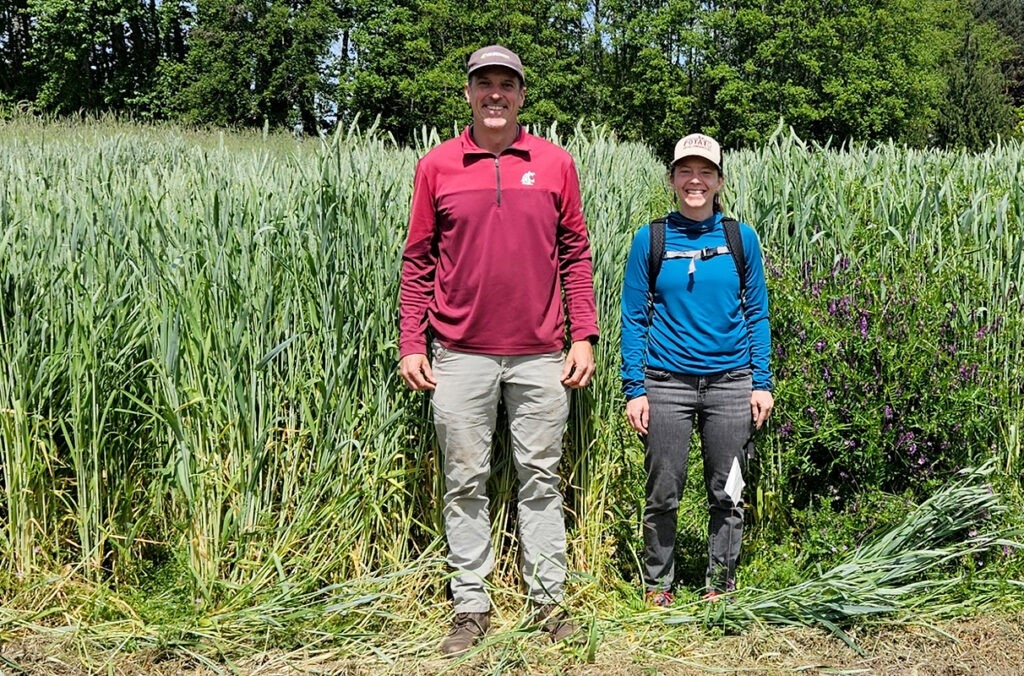
New research has found cover crops which are viable in Washington’s normal off season don’t hurt the soil and can be sold as a biofuel source.
After harvest, farmland often sits fallow and unused until growers seed in the next crop.
Soil can erode, weeds can take root, and farmers don’t make any money during that time.
Cover crops can eliminate or reduce some of those issues, but many farmers have concerns about their effects on soil quality, a reduced growing window for their primary crop, and the inability to sell the cover crop.
In a paper recently published in the journal Biomass and Bioenergy, a team led by Washington State University scientists looked at four cover crops grown for multiple years in western and central Washington fields.
Two showed promising results.
Triticale, a hybrid of wheat and rye, produced the highest yields, and hairy vetch, a vine-like legume with hairy leaves, provided stable yields at low costs while adding nitrogen to the soil.
Miki Santosa, a graduate student in WSU’s Department of Biological Systems Engineering and corresponding author on the paper says the idea is to unlock new cover crop supplies.
“We don’t want to harm the economics for farmers or hurt the soil, so we looked closely at pain points farmers experience when cover crops are used.”
The project is a joint venture between WSU and the Pacific Northwest National Laboratory, where Miki is also a chemical engineer.
The team also looked at biofuel potential for each cover crop.
That was aided by a new technique called hydrothermal liquefaction, during which the harvested crops, called biomass, are processed into fuel.
“The ultimate goal is to provide refineries and processors with more biomass and renewable feedstocks,” Miki says.
“Working with farmers and the agriculture industry to find suitable crops is vital to reaching that goal.”
Currently, any crop used for biofuel has its own specialised process for how biomass is converted into fuel.
Which makes it difficult to establish a market when, for example, corn undergoes an entirely different process than soybeans.
Hydrothermal liquefaction allows processors to mix different types of biomass to produce biofuel.
The study shows each crop included in the field trials can be processed into biofuels through the liquefaction process.
Chad Kruger, director of WSU’s Centre for Sustaining Agriculture and Natural Resources and a co-author on the paper said if processors can homogenise different materials to make fuel, that lets us think about growing a variety of crops that work well in different areas.
Cover crops are often grown only to be ploughed back into the soil. They help reduce erosion, address soil compaction, and replenish biomass into the soil.
One of the biggest concerns for growers is ensuring cover crops don’t impact their cash crops by decreasing soil nutrients, pulling moisture from the soil, or reducing the growth window for the more financially important crop.
The research team also studied if removing the biomass from fields reduced the benefits normally derived from cover crops.
“We found removing the biomass, especially from triticale, which grew very abundantly, didn’t hurt the soil,” Chad says.
More study is required, but the research team is excited farmers may one day be able to grow an additional crop which will help both their land and their bottom line, while increasing the amount of biofuel produced.
“Cover crops have always been grown to help the soil, but now farmers may actually be able to get paid for them as well,” Chad explains.
“Add that to the benefits of biofuels, and it’s a positive for everyone.”